Executive Summary: Why Game Design & Development Matters for Businesses in NSW
Game design and development have evolved far beyond entertainment, emerging as a powerful tool for businesses across New South Wales seeking digital engagement and measurable ROI. Companies throughout Sydney, Newcastle, and regional NSW are leveraging custom game development to create immersive marketing campaigns, deliver interactive training modules, and build gamification strategies that drive customer retention and brand awareness.
The business game development solutions landscape in Australia offers unique opportunities. From startups prototyping innovative products to established enterprises developing training simulations for healthcare and manufacturing, professional game development delivers tangible business outcomes through enhanced user engagement and data-driven insights.
NSW businesses benefit from a thriving local ecosystem supported by Screen NSW funding programs, world-class talent from institutions like UTS and TAFE NSW, and a collaborative community of studios offering scalable solutions. Whether you’re exploring gamification for a mobile app or planning a full-scale AR marketing experience, understanding the game development process is essential for making informed investment decisions and achieving product innovation that supports business growth.
Definitions: Game Design vs Game Development (Quick, Clear)
What Is Game Design?
Game design focuses on the creative and conceptual framework that makes interactive experiences engaging and purposeful. Game designers craft game mechanics—the rules and systems governing player actions—alongside level design that structures progression and challenge. They apply game design principles rooted in user experience (UX) and user interface (UI) design, ensuring players can navigate systems intuitively while staying engaged.
The role encompasses storytelling and narrative design, character design that creates memorable protagonists and antagonists, and the careful balance of challenge and reward. For businesses, game design translates into understanding how gameplay design can drive specific outcomes: keeping users in a training module longer, encouraging customers to complete onboarding flows, or creating memorable brand interactions that increase awareness.
What Is Game Development?
Game development represents the technical execution that transforms design concepts into functioning digital products. Developers work with game engines like Unity and Unreal Engine to program interactive systems, integrate art assets, implement audio, and conduct rigorous testing and QA to ensure performance across target platforms.
The video game design process includes programming gameplay logic, building multiplayer functionality for social experiences, optimizing performance for different devices, and establishing post-launch support infrastructure. Development teams handle cross-platform development to ensure games run smoothly on mobile, PC and console game development environments, and increasingly, web-based platforms.
How They Work Together
Game design vs game development isn’t a competition—it’s a partnership. The game development lifecycle explained simply shows designers creating prototyping documents and wireframes while developers build testable versions, iterate based on playtesting feedback, and refine until the experience meets business objectives. This iterative pipeline ensures creative vision aligns with technical feasibility, keeping projects on schedule and within budget while maintaining quality standards essential for professional outcomes.
Typical Game Development Pipeline (Step-by-Step)
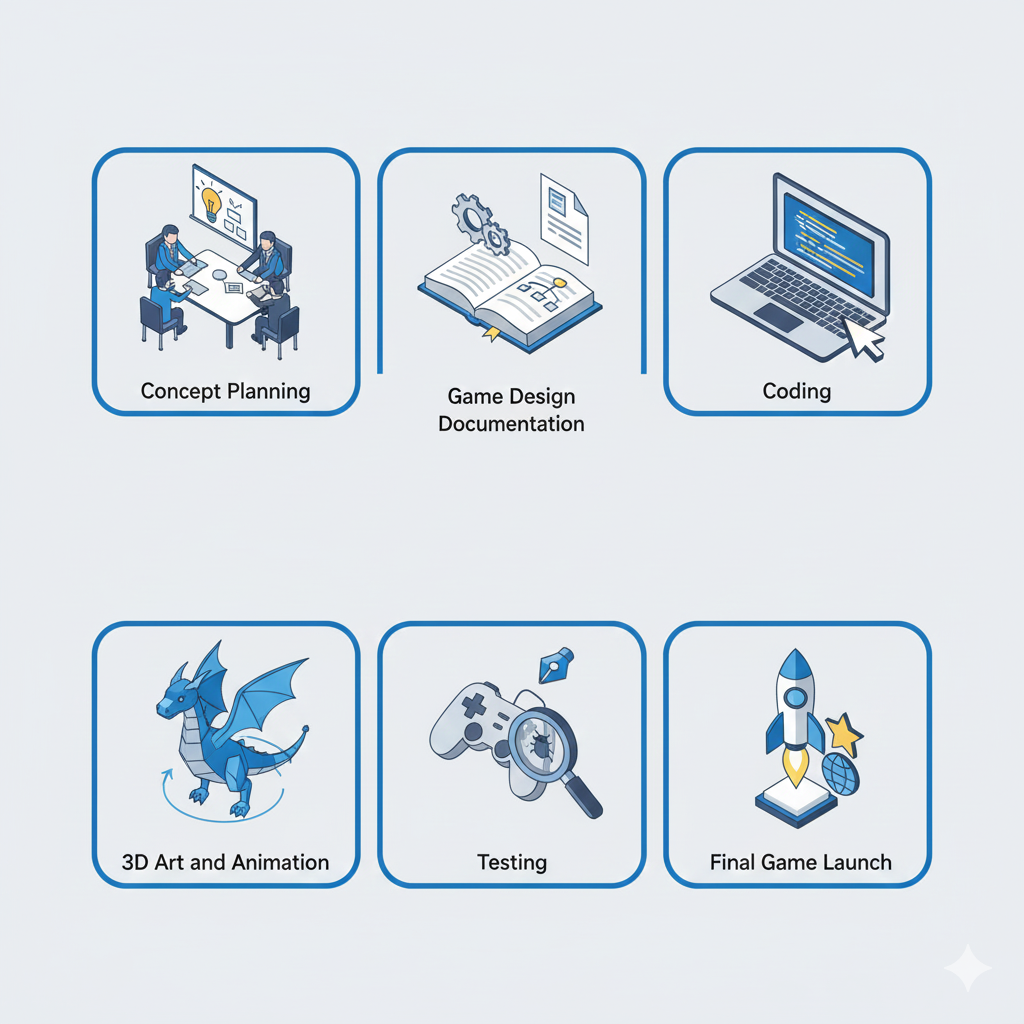
Concept & Ideation (Business Goals, Target Audience)
Every successful project begins by defining business objectives and understanding the target audience. During concept development, stakeholders identify whether they need video game design for a marketing campaign, custom game development for training programs, or enterprise game development supporting internal operations. Teams research competitors, validate assumptions about user needs, and establish measurable success criteria.
This phase for businesses using gamification might involve analyzing customer behavior data, identifying engagement gaps in existing products, or exploring how game development for brands can differentiate market positioning. Clear documentation of goals, constraints, and success metrics creates alignment before significant resources are committed.
Pre-Production: GDD (Game Design Document), Budget, Tech Stack
Pre-production formalizes the concept into actionable plans. The Game Design Document becomes the project bible, detailing mechanics, user flows, technical requirements, art style, and content scope. Business stakeholders work with development teams to establish realistic budgets covering personnel, software licenses, asset creation, and contingency buffers.
Technology decisions made here—choosing between Unity for flexibility or Unreal Engine for high-fidelity graphics, selecting mobile game development frameworks versus PC platforms, determining whether VR and AR games fit the use case—shape the entire production trajectory. Teams also establish monetization models if applicable, plan for scalability to accommodate growth, and define what post-launch support will entail.
Production: Programming, Art, Audio, Integration
Production is where game development services deliver tangible progress. Programmers implement gameplay systems, UI elements, and backend services while artists create character models, environments, and animations. Audio designers craft sound effects and music that enhance immersion and emotional impact.
This phase demands careful integration across disciplines. Version control systems and collaboration tools keep distributed teams synchronized. Regular builds allow stakeholders to experience work-in-progress, provide feedback, and catch issues early. For business game development solutions, this stage often includes building analytics hooks to track user behavior and measure the ROI of interactive experiences after launch.
Testing & QA: Playtesting, Bug Triage, Localisation
Quality assurance transforms functional builds into polished products. Playtesting with representative users reveals usability problems, confusing mechanics, and engagement drop-off points. QA testers systematically document bugs, developers prioritize fixes, and the cycle repeats until stability and performance meet requirements.
For businesses targeting diverse markets, localisation adapts content for different languages and cultural contexts. Testing also validates accessibility features, ensuring experiences work for users with different abilities—a consideration increasingly important for corporate training applications and public-facing brand experiences.
Launch & Post-Launch: Live Ops, Analytics, Updates/Patches
Launch marks the beginning of a product’s public life, not its end. Modern game development for businesses emphasizes live ops—ongoing content updates, feature additions, and community engagement that sustain long-term value. Analytics platforms track how users interact with experiences, revealing optimization opportunities and informing future development priorities.
Businesses benefit from establishing update schedules that keep content fresh, bug-fix protocols that maintain reliability, and feedback mechanisms that demonstrate responsiveness to user needs. This approach transforms one-time projects into evolving platforms that deliver compounding returns on initial investments.
Key Roles & Skills Businesses Will Meet / Hire
Game Designer (Systems, Level, Narrative)
Game designers architect the player experience from conceptual foundations to detailed implementations. Systems designers define core mechanics and progression loops, level designers craft individual challenges and spatial layouts, and narrative designers write storylines and dialogue that create emotional connections. For businesses, designers translate strategic objectives into engaging interactive frameworks that drive desired user behaviors.
When evaluating game design and development services, businesses should assess designers’ portfolios for projects with similar goals—whether creating compelling training scenarios, designing retention-focused gamification systems, or building brand experiences that communicate complex value propositions memorably.
Programmer / Engineer (Unity, Unreal, Web Tech)
Developers translate design specifications into functional code. Unity programmers often work on mobile game development and cross-platform projects requiring rapid iteration. Unreal Engine developers typically focus on high-fidelity experiences leveraging advanced rendering capabilities. Web developers build browser-based experiences using HTML5, WebGL, and JavaScript frameworks.
Backend engineers handle server infrastructure, database design, user authentication, and API development supporting multiplayer functionality or persistent user data. For businesses, technical expertise determines whether ambitious features are feasible within budget and whether experiences will perform reliably at scale.
Artist & Animator
Visual artists create the aesthetic identity that makes experiences distinctive and appealing. 2D artists design UI elements, icons, and stylized graphics. 3D artists model characters, environments, and props that populate virtual spaces. Animators bring static assets to life through movement that communicates personality and responsiveness.
Art direction decisions—realism versus stylization, vibrant versus muted palettes, detailed versus minimalist approaches—profoundly influence how audiences perceive brands and engage with content. Businesses should evaluate artistic capabilities against their brand guidelines and target demographic preferences.
Audio Designer
Sound design shapes emotional resonance and immersion in ways visual elements alone cannot achieve. Audio designers create sound effects that provide feedback for player actions, compose music that sets tone and pacing, and implement spatial audio systems that enhance realism in VR experiences.
For business applications, audio contributes to brand identity (recognizable sonic signatures), accessibility (audio cues for visually impaired users), and engagement (satisfying feedback sounds that reinforce desired behaviors in gamification systems).
Producer / Project Manager / QA
Producers coordinate teams, manage schedules, communicate with stakeholders, and make scope decisions that keep projects viable. Project managers apply methodologies like Agile or Waterfall to organize work, track progress, and mitigate risks. QA specialists ensure quality through systematic testing, documentation, and validation against requirements.
These roles determine whether projects deliver on time and budget. For businesses evaluating game development companies, ask about project management approaches, communication cadences, and how they handle scope changes or unexpected challenges.
Outsourcing vs In-House: What Businesses Should Consider (Cost, Control, IP)
Building internal game development capabilities provides maximum control and accumulated expertise but requires significant upfront investment in talent, tools, and infrastructure. Outsourcing to specialized studios offers access to established expertise and faster time-to-market but necessitates clear contracts addressing IP ownership, change management, and ongoing support.
Many businesses adopt hybrid models: outsourcing initial development to validate concepts while building internal capacity to manage live operations and iterative improvements. Consider factors like project frequency (occasional versus continuous need), strategic importance (core differentiator versus supporting tool), and available capital when making this decision.
Technology & Tools (Practical for Decision Makers)
Popular Engines: Unity, Unreal, Godot—Which Suits Which Business Use Case
Unity dominates mobile game development and cross-platform projects, offering extensive asset libraries, accessible pricing, and strong AR/VR support. Its versatility makes it ideal for businesses developing gamification for customer retention, training simulations, or moderate-fidelity interactive marketing experiences. Unity’s web export capabilities enable browser-based deployments with minimal friction.
Unreal Engine excels when visual fidelity matters most—architectural visualizations, high-end brand experiences, PC and console game development targeting enthusiast audiences. Its blueprint visual scripting empowers designers to prototype without programming expertise, while C++ foundations support performance optimization for demanding applications.
Godot offers an open-source alternative with no licensing fees, appealing to cost-conscious projects and businesses preferring community-driven ecosystems. While its ecosystem is smaller than Unity or Unreal, Godot suits 2D projects and lightweight 3D applications where cutting-edge graphics aren’t primary requirements.
Tools for Art / Audio / Analytics / CI & Collaboration
Production pipelines integrate specialized tools addressing specific needs. Blender, Maya, and 3ds Max handle 3D modeling and animation. Photoshop and Substance Painter create textures and materials. Audacity, FMOD, and Wwise manage audio asset creation and implementation.
Analytics platforms like Unity Analytics, GameAnalytics, and custom solutions track user behavior, providing data-driven insights that inform optimization decisions. Version control systems (Git, Perforce) manage code and asset changes across teams. Continuous integration tools automate builds and tests, catching issues quickly.
Collaboration platforms like Slack, Trello, Jira, and Confluence keep distributed teams aligned. For businesses, understanding the tool ecosystem helps evaluate vendors’ technical maturity and their capacity to deliver scalable solutions with robust post-launch support.
Emerging Tech: VR/AR, Cloud Gaming, AI-Assisted Development (Note Business Impacts)
Virtual and augmented reality transforms training applications, allowing employees to practice procedures in safe, immersive environments. Retailers use AR to let customers visualize products in their spaces before purchasing. Event marketers create memorable brand activations through VR experiences that transport audiences to impossible locations.
Cloud gaming eliminates hardware barriers, enabling high-fidelity experiences on lightweight devices by streaming from remote servers. For businesses, this democratizes access to sophisticated interactive experiences without requiring users to own expensive equipment.
AI-assisted development accelerates asset creation through procedural generation, automates testing through intelligent bug detection, and even generates code suggestions that speed implementation. These technologies reduce costs and timelines while enabling more ambitious creative visions within constrained budgets.
Business Cases: How Companies Use Games (With NSW Examples You Can Localise)
Marketing & Brand Experiences (Virtual Brand Worlds, Events)
Brands increasingly create interactive experiences that forge deeper connections than passive advertising. Fashion companies build virtual showrooms where customers explore collections interactively. Event organizers supplement physical conferences with digital spaces extending engagement beyond venue constraints. Game development for marketing campaigns transforms one-way messaging into two-way conversations where users actively participate in brand narratives.
Interactive game development for these applications emphasizes shareability, data capture, and measurable conversion pathways. Sydney-based businesses can leverage local talent to create culturally relevant experiences resonating with Australian audiences while maintaining production costs competitive with international alternatives.
Training & Simulation (Health, Manufacturing, Retail)
Healthcare providers use simulation games to train staff on emergency procedures without risk to patients. Manufacturers create virtual factories where workers learn equipment operation before touching expensive machinery. Retail companies develop role-playing scenarios training employees on customer service skills and conflict resolution.
Game development for training and education delivers measurable business outcomes: improved retention compared to traditional instructional methods, reduced training time through engaging interactive formats, and standardized assessment through built-in performance tracking. NSW businesses benefit from government training initiatives that may subsidize development costs for workforce development applications.
Gamification for Customer Retention & Apps
Mobile apps incorporate game mechanics—points, badges, leaderboards, challenges—to encourage regular usage and habit formation. Fitness apps reward consistency, financial apps incentivize saving goals, loyalty programs create progression systems that increase customer lifetime value.
Benefits of game development for companies implementing gamification include increased daily active users, higher completion rates for onboarding flows, and enhanced data collection about user preferences and behaviors. The key lies in aligning incentives with genuine value delivery rather than manipulative dark patterns that erode trust.
Product Prototyping & Research
Interactive prototypes let businesses test product concepts with users before committing manufacturing resources. Game engines enable rapid iteration on interface designs, test different feature combinations, and gather quantitative data about which variations perform best.
Custom game development for startups often begins with prototyping—validating core assumptions about target audiences and value propositions through playable demonstrations that communicate vision more effectively than static presentations or written descriptions.
Budgeting & Timeline: What Businesses Should Expect
Rough Cost Bands (Prototype / MVP / Full Production)
Simple prototypes demonstrating core mechanics typically cost $15,000–$50,000 AUD and require 6–12 weeks. These validate concepts and provide tangible artifacts for stakeholder alignment and funding discussions.
Minimum viable products (MVPs) with polished core features, basic art, and deployment to target platforms range from $50,000–$200,000 AUD across 3–6 months. MVPs enable early user testing and iterative refinement based on real-world feedback.
Full production titles with extensive content, sophisticated systems, and professional polish span $200,000–$1,000,000+ AUD over 12–24 months. These represent significant investments justified by strategic importance, large potential audiences, or complex requirements where quality directly impacts business outcomes.
NSW contractor rates for experienced developers typically range $80–$150 per hour, while specialized roles (senior engineers, technical artists) command $120–$200 per hour. Studio day rates averaging $800–$1,500 include overhead, project management, and resource flexibility.
How Scope, Platform (Mobile/PC/Console/Web) and Live-Service Features Affect Cost and Time
Platform choices multiply development efforts. Mobile game development targeting both iOS and Android requires testing across diverse devices with varying performance characteristics. PC and console game development demands certification processes, performance optimization for fixed hardware, and integration with platform-specific services (achievements, cloud saves).
Cross-platform development increases initial costs 20–40% compared to single-platform focus but expands potential audiences and delivers better ROI for businesses seeking maximum reach. Web deployment offers the lowest friction for user acquisition but may constrain graphical ambition and gameplay complexity.
Live-service features—ongoing content updates, community management, seasonal events—transform one-time development into ongoing operational expenses. Budget for server infrastructure, customer support, and dedicated content teams when planning experiences requiring persistent engagement.
Legal, IP & Compliance for Businesses in Australia / NSW
Ownership & Contributor Agreements (Games Include Art, Code, Audio)
Interactive experiences incorporate copyrighted assets from multiple contributors—programmers, artists, writers, composers. Clear contracts must establish who owns intellectual property created during development and under what terms businesses can use, modify, and commercialize resulting works.
Work-for-hire agreements typically transfer ownership to the commissioning business, but independent contractors may retain rights unless explicitly assigned. When outsourcing to studios, ensure contracts address IP ownership, especially if planning sequels, adaptations, or licensing to third parties. The Arts Law Centre of Australia provides resources explaining complexities of creative rights management relevant to game development projects.
Regulatory Considerations (Gambling Content & the Interactive Gambling Act; NSW Unlawful Gambling Laws)
Businesses incorporating randomized rewards, loot boxes, or other monetization models must understand Australian gambling regulations. The Interactive Gambling Act prohibits certain online gambling services, while NSW unlawful gambling laws apply additional restrictions on games of chance involving real-money transactions.
Even virtual currencies and cosmetic items can trigger regulatory scrutiny if implemented carelessly. Consult legal counsel experienced in gaming law before launching experiences with randomized rewards, particularly those targeting minors. Screen NSW guidance documents address these considerations for local developers.
How to Pick a Studio or Vendor in NSW (Practical Checklist)
Questions to Ask (Portfolio, Live Ops, Post-Launch Support, IP Terms)
Review portfolios critically: Do previous projects demonstrate relevant experience with your target platform, complexity level, and audience? Ask about specific roles studio personnel played—did they handle entire productions or contribute specific components?
Clarify post-launch support terms upfront. What constitutes a bug versus a feature request? How quickly will critical issues be addressed? What ongoing maintenance is included versus billed separately? Understanding these details prevents surprises after launch.
Discuss IP ownership explicitly. Ensure contracts specify that all project assets become your property (excluding pre-existing tools and frameworks the studio licenses separately). Verify studios won’t reuse your unique content in other client projects without permission.
Red Flags & Contract Tips
Beware vendors unwilling to provide references, those lacking documented processes, or claiming unrealistic timelines relative to scope. Studios that can’t articulate clear methodologies for handling scope changes or those using outdated technology stacks may struggle delivering modern experiences meeting user expectations.
Contracts should include milestone-based payment structures tying compensation to demonstrated progress, provisions addressing how disagreements are resolved, and termination clauses protecting both parties if circumstances change dramatically. Consider engaging legal counsel experienced in software development agreements to review terms before signing.
Measuring ROI: KPIs for Business Games & Experiences
Engagement Metrics (DAU/MAU, Session Length)
Daily and monthly active users (DAU/MAU) track how many unique individuals use experiences regularly. High DAU/MAU ratios indicate strong retention—users return frequently rather than churning after initial trials. Session length reveals how long users remain engaged per visit, signaling whether content provides sufficient value to justify time investment.
For training applications, completion rates and time-to-competency measure effectiveness. Marketing experiences track participation rates, social shares, and brand recall improvements. These metrics provide quantitative foundations for calculating ROI and justifying continued investment.
Conversion & Attribution (Tracking Uplift from Campaigns)
Interactive experiences should include analytics tracking user pathways from initial engagement through desired conversion actions—purchases, sign-ups, content shares. Attribution modeling connects game interactions to downstream business outcomes, demonstrating concrete value creation.
Implement A/B testing comparing users exposed to interactive experiences against control groups receiving traditional marketing. Measure differences in conversion rates, average order values, and customer lifetime value. These comparisons quantify game development’s incremental contribution versus other marketing investments.
Training Outcomes (Retention, Assessment Metrics)
Training games should demonstrate improved knowledge retention compared to traditional methods, validated through pre- and post-assessments. Track error rates, time-to-proficiency, and real-world application of skills learned through simulation.
Calculate cost-per-trained-employee including development costs amortized across expected user numbers. Compare against traditional training expenses (instructor time, travel, facility costs) to demonstrate efficiency gains. Long-term tracking validates whether training effects persist or decay over time.
6 Practical Next Steps for NSW Businesses (CTA)
1. Explore Rapid Prototype Options: Contact local studios about pilot projects scoping $20,000–$40,000 budgets validating core concepts before committing to full production. These de-risk investments while generating tangible artifacts demonstrating potential to internal stakeholders.
2. Apply for Screen NSW or Local Grants: Research funding programs supporting interactive media development. Even if your project doesn’t qualify initially, understanding criteria helps shape future initiatives toward fundable directions while connecting with ecosystem resources.
3. Contact Local Education Providers: Reach out to TAFE NSW, Torrens University Australia, and UTS about internship partnerships or graduate recruitment. Engaging emerging talent provides cost-effective resources while contributing to workforce development benefiting the broader industry.
4. Build an Evaluation Brief: Create a one-page document summarizing your business objectives, target audience, technical requirements, budget constraints, and timeline expectations. Distribute this to studios to receive comparable proposals simplifying vendor evaluation.
5. Schedule Discovery Consultations: Arrange calls with multiple studios to discuss your vision, assess cultural fit, and gauge communication clarity. Use these conversations to ask questions from the checklist above and evaluate each vendor’s problem-solving approach.
6. Leverage Professional Expertise: Partner with experienced studios offering comprehensive game design and development services that align technical execution with strategic business objectives, ensuring your investment delivers measurable results.