Virtual reality is a simulated reality created through 3D virtual environments that users experience via VR headsets like Meta Quest, HTC Vive, or PlayStation VR. For Australian businesses, this immersive technology is transforming how companies train employees, design products, and engage customers. Take Mindflight7, an Australian company bringing immersive learning to schools nationwide, proving that virtual reality technology isn’t just for gaming—it’s a powerful business tool.
What is Virtual Reality?
Virtual reality systems create real-time interaction within digital spaces through specialized hardware and software. Users wear VR headsets equipped with controllers that track movement in three degrees of freedom (3DOF) for rotation or six degrees of freedom (6DOF) for full spatial movement. These systems can be standalone devices or tethered to computers for enhanced processing power.
While augmented reality overlays digital content onto the real world and mixed reality blends both environments, VR for businesses offers complete immersion. This distinction matters because total immersion drives deeper engagement during employee training simulations, product visualisation, and customer engagement experiences. The technology enables human-computer interaction that feels natural, making complex concepts easier to grasp and remember.
Top VR Use Cases for Businesses
Immersive Employee Training & Safety
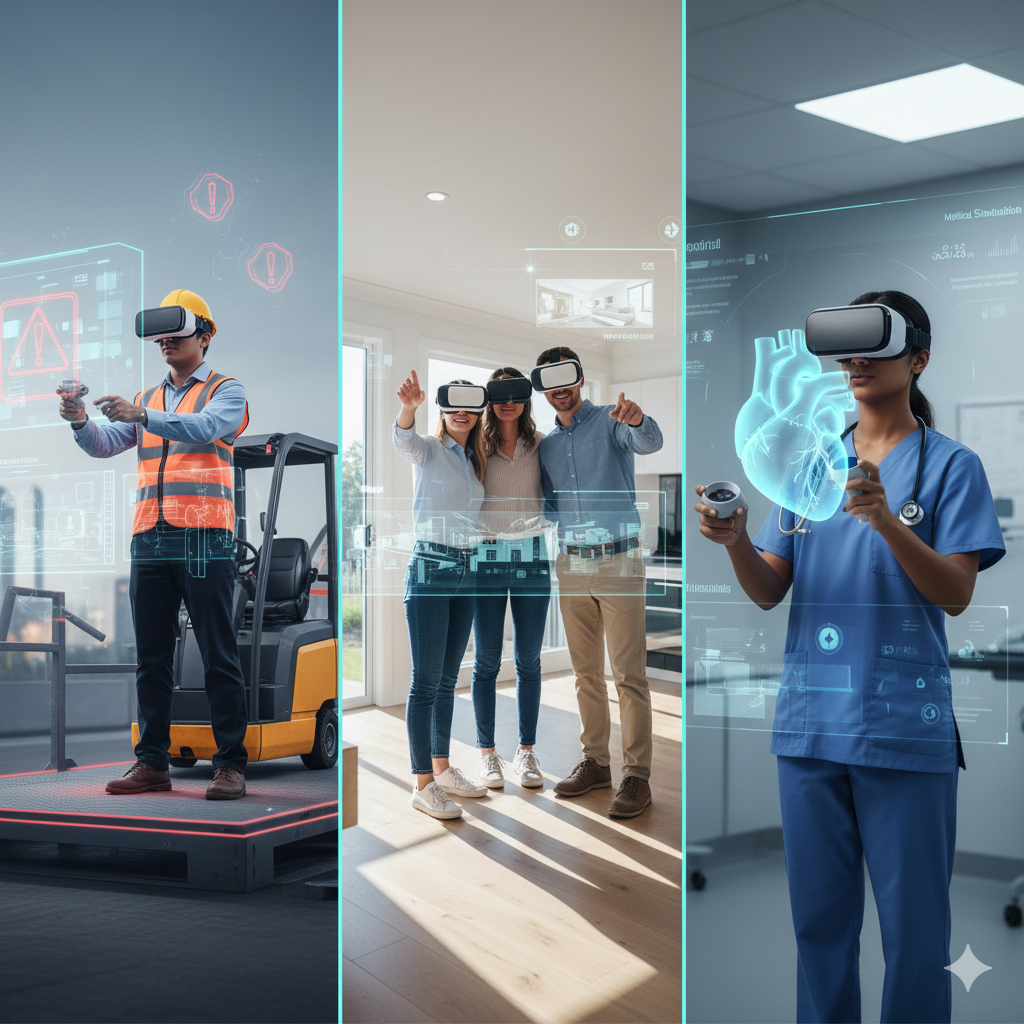
Virtual reality for corporate training delivers risk-free practice environments where mistakes become learning opportunities without real-world consequences. Australian police forces have adopted VR training programs developed by companies like XReality to simulate high-pressure scenarios. The Endeavour Foundation uses VR business applications to help people with disabilities practice workplace skills in safe, controlled settings. These immersive experiences allow unlimited repetition until mastery, with measurable performance data tracking progress—benefits impossible with traditional training methods.
Product Design, Prototyping & Engineering Reviews
VR technology for companies accelerates the design process through digital transformation. Engineering teams review full-scale prototypes in 3D virtual environments before manufacturing begins, catching design flaws early and reducing costs. This approach to spatial computing enables remote collaboration where team members across continents examine the same virtual walkthrough simultaneously, providing feedback in real-time. The result is faster iterations and better products.
Sales, Marketing & Virtual Showrooms
Commercial virtual reality is reshaping how businesses showcase offerings. Real estate agencies across Australia use VR for real estate virtual tours, allowing international buyers to explore properties without flying in. Retail companies create virtual showrooms where customers interact with products through immersive experiences before purchasing. This VR in retail and eCommerce strategy increases conversion rates by letting customers visualize products in realistic contexts.
Healthcare & Therapy
Virtual reality in healthcare Australia includes medical training where surgeons practice complex procedures and therapy programs for pain management and mental health treatment. Medical students gain hands-on experience with rare conditions through simulations, while patients benefit from VR-assisted rehabilitation programs. These VR solutions for business demonstrate measurable improvements in both training outcomes and patient recovery rates.
Education & Immersive Learning
Educational institutions partner with providers like Mindflight7 to integrate immersive technology for business education. Students explore historical sites, conduct virtual science experiments, and develop practical skills through immersive learning modules. Engagement and retention rates significantly exceed traditional teaching methods, making enterprise virtual reality a valuable investment for forward-thinking schools.
Real Australian Case Studies
Mindflight7 partnered with Australian schools to deliver curriculum-aligned VR content, reporting increased student engagement and improved learning outcomes across participating institutions.
XReality developed police training simulations for Australian law enforcement, enabling officers to practice de-escalation techniques and emergency response in realistic scenarios without physical risk.
Endeavour Foundation launched disability employment training using VR systems, helping participants build workplace confidence and skills in controlled environments before entering real jobs.
These virtual reality examples in business show tangible results: reduced training costs, improved safety, and better prepared employees.
How Much Does Business VR Cost in Australia?
VR business solutions in Australia typically range from AUD 5,000–30,000 for pilot programs including basic hardware and custom content development. Scaled implementations with multiple headsets, ongoing content updates, and platform licensing run AUD 30,000–250,000+. Costs vary based on content complexity, hardware choices, and support requirements.
Australian businesses should explore state innovation programs and potential grants supporting digital transformation initiatives. Starting with a focused pilot allows companies to demonstrate ROI before committing to larger investments in virtual reality applications.
How to Evaluate & Start a VR Project
Define objectives: Identify specific business problems VR will solve, whether training efficiency, design speed, or customer engagement.
Choose KPIs: Establish metrics like task completion time, error reduction, learner confidence scores, or customer satisfaction ratings.
Pilot content: Develop a small-scale test with real users to validate effectiveness and gather feedback.
Select hardware: Choose appropriate VR headsets and controllers based on use case requirements and budget.
Measure results: Compare performance against baseline metrics to quantify impact.
Scale strategically: Expand successful pilots while refining based on lessons learned.
Australian SMEs should partner with local XR firms offering expertise in content creation and implementation. Start small, prove value, then expand.
FAQ
What is virtual reality for business?
Business use of virtual reality involves immersive technology creating 3D environments for training, product development, marketing, and customer experiences that drive measurable business outcomes.
How are Australian companies using virtual reality today?
VR companies in Australia deploy solutions across training, healthcare, education, real estate, and manufacturing, with growing adoption in retail and professional services.
Is VR suitable for small businesses in Australia?
Yes. Pilot programs starting around AUD 5,000–15,000 make virtual reality accessible to small businesses, particularly for training and customer demonstrations.
What industries use virtual reality the most?
Healthcare, education, real estate, manufacturing, and retail lead adoption, though metaverse technologies are expanding VR business applications across all sectors.
How expensive is VR for businesses?
Entry-level pilots cost AUD 5,000–30,000, while comprehensive programs range from AUD 30,000–250,000+ depending on scope, hardware, and custom content needs.
Conclusion
Virtual reality in business has moved from experimental to essential for Australian companies seeking competitive advantages. Whether improving safety through immersive training, accelerating product development, or creating memorable customer experiences, VR technology offers proven benefits with measurable ROI.
Ready to explore how businesses use virtual reality today? Ryzr Studios can help you evaluate options and launch your pilot program. Contact us to discuss virtual reality use cases in business that align with your specific goals.